
Services > Building Performance Testing > HERS Ratings
HERS Energy Rating Services
A HERS energy rating turns a home’s efficiency from a claim into a measured, documented number. Builders and homeowners rely on that number to prove code compliance, qualify for incentives, and show buyers how the house was built. Because of the HERS system, the value of efficiency measures can be added to the mortgage price of a registered home. At Home Energy Consultants, Inc., we provide certified HERS rating services from the first foundation pour through final verification.
What Is a HERS Energy Rating?
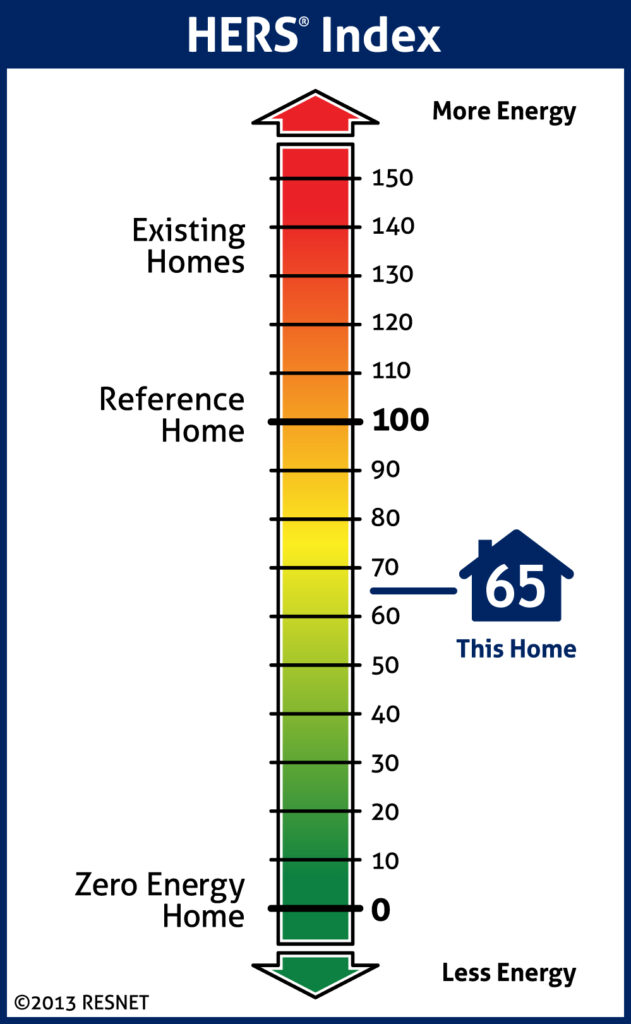
The Home Energy Rating System, administered by RESNET, is the national standard for scoring residential energy performance. A certified rater builds an energy model of the home, verifies and documents the installed details on site, and produces a score on the HERS Index. The index is anchored at 100, which represents a reference home built to a standard baseline, and lower scores indicate better performance. A score of zero describes a net zero energy home.
Why a HERS Energy Rating Matters
A rating is more than a certificate filed at closeout. It gives everyone on the build a verifiable measure of quality.
Energy Code Compliance Through the ERI/Performance Path
A rating opens the Energy Rating Index path to code compliance, which allows trade-offs between assemblies and equipment instead of meeting every prescriptive requirement. Paying for a HERS rater to complete this kind of modeling can save thousands on material and labor costs because the software helps builders and homeowners get the most value per dollar spent on efficiency.
Verified Value at Appraisal and Resale
Each rated home receives a certificate listing the measures we confirmed on site which appraisers, lenders, and buyers can use during mortgage and resale transactions. Every HERS rated home is entered into a National Registry maintained by the non-profit Residential Energy Services Network (RESNET.us) which is available for review on their website.
Quality Control While the Work Is Open
Because verification happens in stages, problems surface early. Missed air sealing, compressed insulation, and duct issues get corrected before drywall covers them, which protects the schedule and budget.
Verification of a HERS rated home happens over several inspections done in the proper sequence. Plan review is important and can find issues with the project before permitting. Framing and air barrier inspections find missed air sealing, verify window and door details and test leaky ducting. Pre-drywall inspection rates insulation installs before drywall covers them, ensuring the best possible result. The house is measured for performance after it is built, and this sequence of inspections ensures the house performs as well as its rating implies.
Our HERS Rating Process
Our involvement spreads across the build rather than compressing into one visit at the end. That rhythm keeps the score predictable and gives the crew usable feedback.
We perform four inspections: at the foundation pour, at framing, at insulation, and at the close of construction. During each visit, we take photographs, measurements, and pressure readings, and we flag any compliance concern directly with the responsible trade. Final testing includes blower door and duct leakage measurements, which feed the energy model behind your score.
When to Schedule Your HERS Energy Rating
The best time to start is during design before permitting. Early modeling lets us compare insulation, window, and mechanical options while changes are still inexpensive. Bringing in a rater late narrows the options if the design falls short, but we can usually suggest changes that will bring the design up to HERS standards.
Plan Your Rating With Us
We work with builders, remodelers, and homeowners who want performance they can document rather than estimate. Tell us about the project, and we will map out the inspection schedule and cost. Reach out to our HERS rating team to get started.
Frequently Asked Questions (FAQs)
1. What counts as a good HERS Index score?
Lower scores are better because they describe a home that uses less energy than the reference baseline. The right target depends on your local code requirements and any incentive program you plan to pursue.
2. How long does the rating process take?
The work spreads across the build, and each site visit usually takes a few hours. Each inspection gives us information to document and build the model. We will stick with you for as long as it takes, which, depending on the house, can be from months to several years.
3. Is a HERS rating the same as a home energy audit?
No. A rating verifies a home against a modeled index and produces a certified score, usually for new construction. An audit diagnoses comfort and efficiency problems in an existing house.